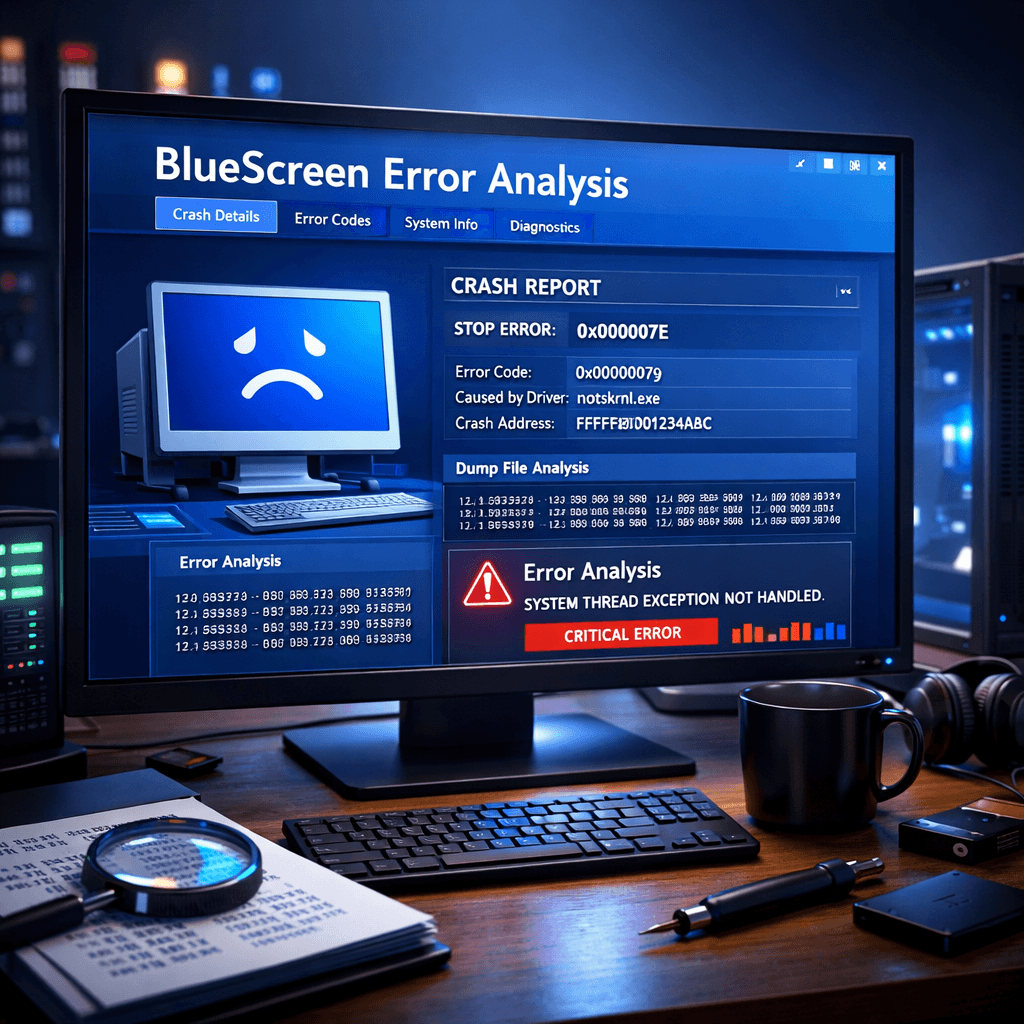
If you are looking for a PC blue screen of death fix, you have come to the right place. The dreaded Blue Screen of Death (BSOD) is one of the most frustrating errors a Windows user can face. Your computer suddenly crashes, shows a blue screen with a sad face, and restarts — sometimes before you even save your work.
Whether your computer keeps blue screening randomly, crashes at startup, or shows a BSOD every few days, the problem is always stressful. But the good news is — most BSOD errors are fixable, even by beginners.
In this guide, we will explain exactly why your PC shows a blue screen and walk you through 10 simple, step-by-step fixes that work on Windows 10 and Windows 11.
Table of Contents
What Is a Blue Screen of Death (BSOD)?
A Blue Screen of Death (BSOD) is a critical error screen that Windows displays when something goes seriously wrong. It forces your computer to stop all operations and restart to prevent damage to your system.
The blue screen usually shows a sad face icon, an error message, and a stop code — for example, SYSTEM_THREAD_EXCEPTION_NOT_HANDLED or CRITICAL_PROCESS_DIED.
A BSOD is Windows telling you: “Something just went wrong that I cannot recover from safely.” It could be a hardware failure, a bad driver, corrupted files, or even overheating.
Common Causes of PC Blue Screen Crashes
Before applying a pc blue screen of death fix, it helps to understand what triggered the crash in the first place. Here are the most common causes:
- Outdated or corrupted device drivers — especially GPU, audio, or chipset drivers
- Faulty RAM (Random Access Memory) — bad memory modules cause random crashes
- Overheating — CPU or GPU running too hot shuts down the system
- Corrupted Windows system files — damaged OS files trigger stop errors
- Failing hard drive or SSD — bad sectors cause unpredictable crashes
- Malware or virus infection — malicious software can destabilize Windows
- Incompatible software or recent Windows Update
- Insufficient power supply or hardware conflicts
How to Read a BSOD Error Code
Every blue screen on your computer shows a stop code. This code tells you exactly what caused the crash. Here is how to use it:
- When your PC blue screens, look at the bottom of the blue screen for a line that says “Stop Code:”
- Write down the stop code — for example:
MEMORY_MANAGEMENTorDRIVER_IRQL_NOT_LESS_OR_EQUAL - Search that code on Microsoft’s official Bug Check Code Reference for exact guidance
Some stop codes give you an immediate clue. For example, DRIVER_IRQL almost always points to a driver problem, while MEMORY_MANAGEMENT often means a RAM issue.
10 Proven PC Blue Screen of Death Fixes
Let us now go through the best solutions to fix a blue screen on your computer. Try these in order — starting with the easiest steps first.
Fix 1: Restart Your PC and Check for Obvious Triggers
Sometimes a single restart is enough if the crash was caused by a one-time glitch. Before doing anything complex:
- Restart your computer normally
- Unplug any USB device, external drive, or printer you recently connected
- Remove any newly installed hardware (like a new RAM stick or GPU)
If your computer blue screened randomly just once after installing something new, removing that item first is the quickest fix.
Fix 2: Update Windows and All Device Drivers
Outdated drivers are the number one cause of BSOD errors. Here is how to update them:
Step 1: Press Windows + I to open Settings
Step 2: Go to Windows Update → Click Check for Updates
Step 3: Install all available updates including optional driver updates
Step 4: Open Device Manager (right-click Start → Device Manager)
Step 5: Look for any device with a yellow warning icon
Step 6: Right-click it → Update Driver → Search Automatically
For GPU drivers, always download directly from NVIDIA’s official website or your graphics card manufacturer’s site.
Fix 3: Run Windows Memory Diagnostic to Check RAM
If your PC keeps blue screening, bad RAM is a common culprit. Windows has a free built-in tool to check it:
Step 1: Press Windows + R, type mdsched.exe, and press Enter
Step 2: Choose “Restart now and check for problems”
Step 3: Your PC will restart and run a memory test automatically
Step 4: After the test, Windows will show you the results
If errors are found, your RAM module may need to be replaced. Try removing one RAM stick at a time and restarting to identify the bad one.
Fix 4: Run SFC and DISM to Fix Corrupted System Files
Corrupted Windows system files can cause a blue screen computer crash. The SFC scan finds and repairs them automatically:
Step 1: Click Start, type cmd, right-click Command Prompt → Run as Administrator
Step 2: Type the command: sfc /scannow and press Enter
Step 3: Wait for the scan to complete (it takes 10–15 minutes)
Step 4: Then type: DISM /Online /Cleanup-Image /RestoreHealth and press Enter
Step 5: Restart your PC when done
✅ Pro Tip: Always run the DISM command after SFC. SFC fixes individual files, while DISM repairs the Windows component store — they work best together.
Fix 5: Check for Overheating
If your computer keeps getting blue screens during heavy tasks like gaming or video editing, overheating is likely the cause.
- Download a free tool like HWMonitor to check your CPU and GPU temperatures
- CPU temperature should stay below 85°C under load. Above 90°C is dangerous.
- Clean dust from your PC case, CPU fan, and vents using compressed air
- Make sure your PC is in a well-ventilated area
- Consider reapplying thermal paste on the CPU if it is 3+ years old
Fix 6: Uninstall Recently Installed Software or Updates
Did your PC start blue screening after installing a program or Windows update? Roll it back:
Step 1: Go to Settings → Windows Update → Update History
Step 2: Click Uninstall Updates
Step 3: Find the most recent update and uninstall it
Step 4: For software, go to Control Panel → Programs → Uninstall a Program
Step 5: Sort by install date and remove recent apps
Fix 7: Run a Virus and Malware Scan
Malware can corrupt system files and cause your computer to blue screen randomly. Run a full system scan immediately:
- Use Windows Defender (built-in and free): Go to Windows Security → Virus & Threat Protection → Full Scan
- Use Malwarebytes Free for a second opinion scan
- Quarantine and delete any threats found
- Restart your PC after the scan
Fix 8: Check Your Hard Drive or SSD for Errors
A failing drive is a serious cause of blue screen on PC startup. Use the built-in CHKDSK tool:
Step 1: Open Command Prompt as Administrator
Step 2: Type: chkdsk C: /f /r and press Enter (replace C: with your drive letter)
Step 3: Type Y when asked to schedule the scan on next restart
Step 4: Restart your PC — the scan will run before Windows loads
⚠️ Warning: If CHKDSK finds many bad sectors, back up your data immediately. Your hard drive may be failing and could need replacement soon.
Fix 9: Perform a System Restore
If your PC blue screen of death fix attempts are not working and the problem started recently, System Restore can take your PC back to a stable state:
Step 1: Press Windows + R, type rstrui, press Enter
Step 2: Click Next and choose a restore point from before the BSOD started
Step 3: Click Finish and confirm
Step 4: Your PC will restart and restore Windows to that earlier state
This will not delete your personal files, but it will undo any recent software installations or driver changes.
Fix 10: Reset Windows (Last Resort)
If nothing else works and your computer blue screen repair is still failing, resetting Windows is the nuclear option — but it almost always works:
Step 1: Go to Settings → System → Recovery
Step 2: Click “Reset this PC”
Step 3: Choose “Keep my files” to preserve your personal data
Step 4: Follow the on-screen instructions and let Windows reinstall itself
✅ Pro Tip: Always choose “Keep my files” during a reset unless your PC cannot even boot properly. A full reset solves 99% of software-related BSOD issues.
Pro Tips to Prevent BSOD in the Future
Once you have applied the blue screen PC fix, here are habits to keep your PC stable long-term:
- 🔄 Keep Windows Updated — always install security and feature updates
- 💾 Keep Drivers Updated — especially GPU, network, and chipset drivers
- 🌡️ Monitor Temperatures — check CPU/GPU temps regularly with HWMonitor
- 🧹 Clean Your PC Every 6 Months — dust buildup causes overheating
- 🛡️ Use Antivirus Software — keep real-time protection enabled at all times
- 💡 Avoid Shady Software — only install apps from trusted, official sources
- 🔋 Use a UPS (Uninterruptible Power Supply) — power surges can damage RAM and SSDs
- 📦 Back Up Your Data — use an external drive or cloud backup regularly
For more detailed maintenance advice, see our guide on
Create Restore Point on Windows PC to Protect Your System From Crashes
Drive Space Issues and How to Clean in 30 seconds tutorial.
Windows BSOD Code Finder
You can also check Microsoft’s official guide on fixing blue screen errors for additional stop code references.
Frequently Asked Questions (FAQs)
Q1. What causes a blue screen of death on a PC?
A BSOD on your PC is usually caused by corrupted or outdated drivers, faulty RAM, overheating, infected system files, failing hard drives, or incompatible software. Reading the stop code on the blue screen helps identify the exact cause for a faster PC blue screen of death fix.
Q2. Why does my computer keep blue screening randomly?
If your computer keeps blue screening randomly, the most common reasons are bad RAM modules, unstable drivers (especially GPU drivers), overheating components, or malware infections. Running a memory diagnostic and updating your drivers usually resolves random BSOD crashes.
Q3. How do I fix a blue screen of death on Windows 11?
To fix a blue screen on PC running Windows 11, start by updating all drivers and running an SFC scan (sfc /scannow in Command Prompt). If crashes continue, check RAM with Windows Memory Diagnostic, scan for malware, and check your hard drive with CHKDSK. As a last resort, reset Windows using the “Keep my files” option.
Q4. Can a blue screen of death damage my computer permanently?
A BSOD itself does not permanently damage your computer — it is a safety feature that stops Windows before more damage can occur. However, the underlying cause (like overheating, failing hardware, or a corrupted drive) can cause permanent damage if left unresolved. Apply a blue screen of death computer fix as soon as possible.
Q5. How do I fix a blue screen on PC startup?
If your PC blue screens on startup, boot into Safe Mode by pressing F8 or F11 during startup. From Safe Mode, run SFC, update or roll back drivers, and uninstall any recent software or updates. If Safe Mode is inaccessible, boot from a Windows installation USB and use Startup Repair.
Q6. Does resetting Windows fix a blue screen of death?
Yes. Resetting Windows (using the “Keep my files” option) resolves most software-related PC blue screen of death issues because it reinstalls Windows while keeping your personal files intact. It removes problematic drivers, corrupted files, and incompatible software that are commonly responsible for BSOD crashes.
Conclusion
Dealing with a PC blue screen of death fix is frustrating, but it is absolutely solvable. In most cases, you do not need to take your computer to a repair shop or spend money on professional help.
Start with the simplest fixes — restarting, updating drivers, and running SFC. Then move to RAM testing, malware scanning, and drive checking if the crashes continue. For stubborn cases, System Restore or a Windows Reset will almost always solve the problem.
The key is not to panic when you see the blue screen on your computer. Write down the error code, follow the steps in this guide, and your PC will be back to normal in no time.
